
Secrets of Legendary Beasts in Forbidden City | Their Stories
This article aims to uncover the hidden meanings and fascinating stories behind the mysterious beasts that guard and decorate the Forbidden City. From roof-riding creatures to symbolic statues at palace gates, these mythical animals were not just artistic flourishes—they were chosen to embody imperial power, offer protection, and reflect ancient beliefs rooted in Chinese cosmology and folklore. Each creature, from the vigilant qilin to the fierce dragon, tells a tale of superstition, symbolism, and the emperor’s heavenly mandate. Join us as we explore the secrets these beasts silently kept for centuries.
Legendary Beasts Designs | Forbidden City Architecture
The term “legendary beasts” encompasses a fascinating array of mythical and symbolic animal figures found throughout the Forbidden City. These include the prominent imperial roof decorations, also known as “ridge beasts” or “walking beasts,” and various other statues and motifs integrated into the Forbidden City‘s design.
Are Imperial Roof Decorations Applied the Legendary Beasts Design?
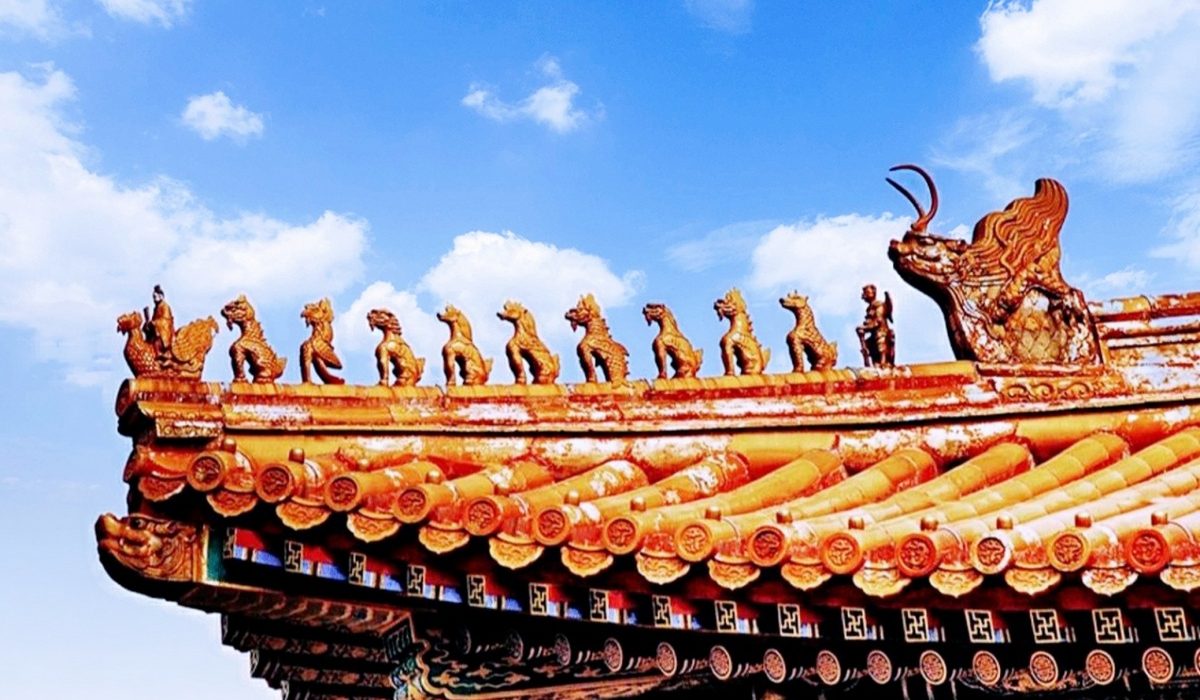
Absolutely. Imperial roof decorations are arguably the most iconic of the legendary beasts. These glazed ceramic statuettes are meticulously arranged along the ridge lines of imperial buildings. Their primary purpose is to ward off evil spirits and visually articulate the building’s importance and the imperial family’s authority and prosperity. The number of these mysterious beasts on a roof directly correlates with the building’s significance, with the most important structures featuring a greater count. The Hall of Supreme Harmony, being the paramount building in the complex, uniquely boasts the maximum of ten mysterious beasts, signifying its unparalleled status.
Beyond the Roofs, Where Else Do Mysterious Beasts Appear?
The presence of mysterious beasts extends far beyond the rooftops. The Forbidden City is replete with animal statues and figures placed strategically across the complex. Lions often guard palace gates, symbolizing protection and strength. Other mythical creatures like tortoises and cranes are found within courtyards, embodying longevity and good fortune. Even windows, columns, and doors are adorned with intricate carvings and patterns of these mysterious beasts, all serving to exorcise evil, invite good fortune, and ensure the continuous blessing of the nation.
What are the Categories of Mysterious Beasts? | Their Meaning
Chinese mythology often categorizes these mysterious beasts based on their symbolic domains. For instance, the majestic dragon reigns supreme among scaled creatures, the elegant phoenix among birds, the auspicious qilin among land animals, and the steadfast tortoise among shelled creatures. This classification underscores their hierarchical significance and their roles within the cosmic order, all embodied by these mysterious beasts.
What Do the Mysterious Beasts Look Like?
The mysterious beasts of the Forbidden City exhibit diverse forms, often blending features of real animals with fantastical elements. They are typically crafted from glazed ceramic for the rooftops, providing vibrant colors and intricate details, or from stone and bronze for statues. Each mysterious beast is designed to convey specific attributes and powers.


Why Do These Mythical Beasts Design Hold Such Significance?
The significance of the mysterious beasts design in the Forbidden City is multifaceted, encompassing protection, the display of imperial power, and profound cultural symbolism.
How Do These Mysterious Beasts Offer Protection?
Many mysterious beasts were believed to possess supernatural abilities to ward off evil spirits, dispel misfortune, and protect against natural disasters. For example, the Ya Yu (窫窳), a dragon-fish hybrid, was thought to summon rain and prevent fires, while the Hangshi(行什), a winged monkey-like creature, was said to deter lightning strikes. These protective roles made the mysterious beasts vital to the palace’s security.
How Do Mysterious Beasts Showcase Imperial Power and Status?
The mysterious beasts serve as powerful visual indicators of imperial power and hierarchical status. The number and specific types of figures on a building’s roof directly communicate its rank. The Hall of Supreme Harmony, as the most prestigious building, is uniquely adorned with ten ridge beasts, a testament to its supreme importance and the emperor’s unparalleled authority. The Dragon, the most revered animal in Chinese culture and a direct symbol of the emperor, is omnipresent throughout the Forbidden City, with over 13,000 dragon patterns adorning the Hall of Supreme Harmony alone. This extensive display, alongside other significant mysterious beasts like the Phoenix (representing the empress), unequivocally communicated the emperor’s divine power and the unparalleled status of the imperial court.
What Symbolic Meaning Do Individual Mysterious Beasts Design Convey?
Each mysterious beast, whether on the roofs or elsewhere in the Forbidden City, carries a distinct meaning and blessing.
- Dragon: The ultimate symbol of imperial power, good fortune, and control over rain and clouds. Emperors were often referred to as “sons of the dragon.”
- Phoenix: The “king of all birds,” representing the empress, grace, virtue, prosperity, and rebirth.
- Lion: A symbol of bravery, majesty, and a guardian figure in Buddhism, believed to protect against evil. The male lion often holds a ball (unity of empire), while the female cradles a cub (royal lineage continuity).
- Sea Horse & Heavenly Steed: These two mysterious beasts symbolize the emperor’s extensive reach and success, extending across both land and sea.
- Suan Ni(狻猊): A fierce lion-like mysterious beast, capable of devouring tigers and leopards, and often associated with incense due to its love for smoke. It symbolizes might and strength.
- Ya Yu (押鱼): A unique blend of fish and beast, often depicted as a horned dragon. It’s believed to control weather and bring rain, making it crucial for fire prevention.
- Xie Zhi (獬豸): A goat-like creature with a single horn, possessing divine power to discern right from wrong and punish the guilty, symbolizing justice and righteousness.
- Dou Niu (斗牛): Resembling a hornless dragon, with similar protective functions to the Yayu, particularly against fire.
- Xing Shi (行什): A monkey-like mysterious beast with wings and a magic weapon, believed to defeat demons and evil spirits and provide protection against thunder. The Hall of Supreme Harmony is the only building to feature Xing Shi.


Frequently Asked Questions and Answers (FAQs) About Forbidden City Mythical Beasts
What is the main purpose of the mysterious beasts on the Forbidden City roofs?
The primary purpose of the mysterious beasts is multifaceted: to provide protection against evil spirits and natural disasters (like fire), to display the emperor’s power and the building’s hierarchical status, and to bring good fortune and prosperity to the empire.
Why is the Hall of Supreme Harmony unique regarding these mysterious beasts?
The Hall of Supreme Harmony is unique because it is the only building in the Forbidden City to feature the maximum number of ten mysterious beasts on its roof. This signifies its unparalleled importance and the emperor’s supreme authority.
Is the number or type of beast the same across the Forbidden City?
No. The number and type of beasts reflect the rank and purpose of the building. Grand halls have more beasts, while secondary structures have fewer. Each animal in the line of guardians also has specific meaning and order.