
Why Number Nine Prevails in the Forbidden City?
This article explores why the number nine (9) holds such a dominant presence in the Forbidden City and uncovers its deep symbolic meaning in Chinese imperial culture. In traditional Chinese cosmology, nine is the highest single-digit odd number and symbolizes supreme yang energy, imperial power, and eternity. Within the Forbidden City, this symbolism is reflected in its design—from the reported 9,999 rooms to the repeating patterns of nine seen in doors, nails, and decorative elements. By delving into these architectural and cultural expressions, the article reveals how the number nine was intentionally embedded to reinforce the emperor’s divine authority.
Why is Number Nine So Important?
The number nine (jiǔ,九) is not merely a numeral in Chinese culture; it is a deeply resonant symbol imbued with layers of meaning, from its pronunciation in Chinese to its deep roots in ancient traditions. This auspicious digit 9 serves as a cornerstone of imperial symbolism, linking the earthly realm with the celestial, and embodying concepts of completeness, longevity, and ultimate power. Its pervasive presence in the Forbidden City is a direct reflection of these deeply held beliefs.
How Does the Pronunciation of Nine Contribute to its Auspiciousness?
In the Chinese language, the sound of “nine” (jiǔ) is a homophone for the word meaning “long-lasting” or “everlasting” (久). This phonetic connection immediately elevates the number beyond a simple count, imbuing it with associations of enduring prosperity, continuity, and an eternal legacy. This is why the number nine often appears in contexts desiring longevity, such as gifts for weddings or celebrations of life, symbolizing a wish for a long and enduring future. For the emperor, this linguistic link directly translated into the aspiration for a long-lasting dynasty and an eternal reign.
What is Nine’s Role in Chinese Traditional Culture?
In Chinese culture, the number nine is more than just a number—it carries deep meaning. As the highest single digit, it stands for completeness and reaching the top. In traditional Chinese philosophy, nine is seen as a powerful number, full of strong, masculine energy. It also has a close connection to the heavens and divine power. Ancient texts like the Yijing (Book of Changes) describe nine as a key number in the natural balance of the universe. Because of this, it became closely linked to the emperor, who was believed to rule with the Mandate of Heaven. The number nine symbolized his special role as the “Son of Heaven.”
How is Number Nine Integrated into the Forbidden City’s Architectural Masterpiece?
The architects and designers of the Forbidden City meticulously wove the number nine into the very fabric of the imperial palace. This wasn’t merely an aesthetic choice but a deliberate act to infuse the complex with symbolic power, reinforcing the emperor’s divine right and supreme authority. From grand dimensions to intricate details, the presence of the number nine is ubiquitous.
In What Ways Do Hall Dimensions Reflect the Supremacy of Nine?
Key structures within the Forbidden City, such as the majestic Hall of Supreme Harmony, were designed with specific dimensions incorporating the number nine. While some later reconstructions might show slight variations, the original symbolic intent dictated halls to be nine bays wide. The combination of nine bays wide (The front façade of the building is divided into nine equal sections by ten vertical columns. ) and five bays deep (From front to back, the building extends into five sections deep) held particular imperial significance, where nine represented the supreme power and five symbolized centrality. This “Nine-Five Supreme” (九五之尊) concept directly linked the architectural grandeur to the emperor’s unmatched position as the central and most powerful figure in the empire.
(A ‘bay’ is a structural unit in traditional Chinese architecture, defined by the space between two pillars. It is the basic measurement for the size of a building.)
Why it is said that forbidden city consists of 9,999 Rooms ?
One of the most enduring legends surrounding the Forbidden City states that it possesses 9,999 rooms, or sometimes 9,999.5 rooms. This number is deliberately set just shy of 10,000, a figure traditionally reserved for the Heavenly Palace of the gods. This subtle yet profound distinction was a mark of respect towards the celestial realm, while simultaneously asserting the emperor’s near-divine status. Although modern surveys indicate a slightly different actual count of rooms (closer to 8,886 or 9,371), the persistence of this legend underscores the symbolic weight of the number nine and its proximity to perfection.
How Do Corner Towers and Door Studs Embody the Number Nine?
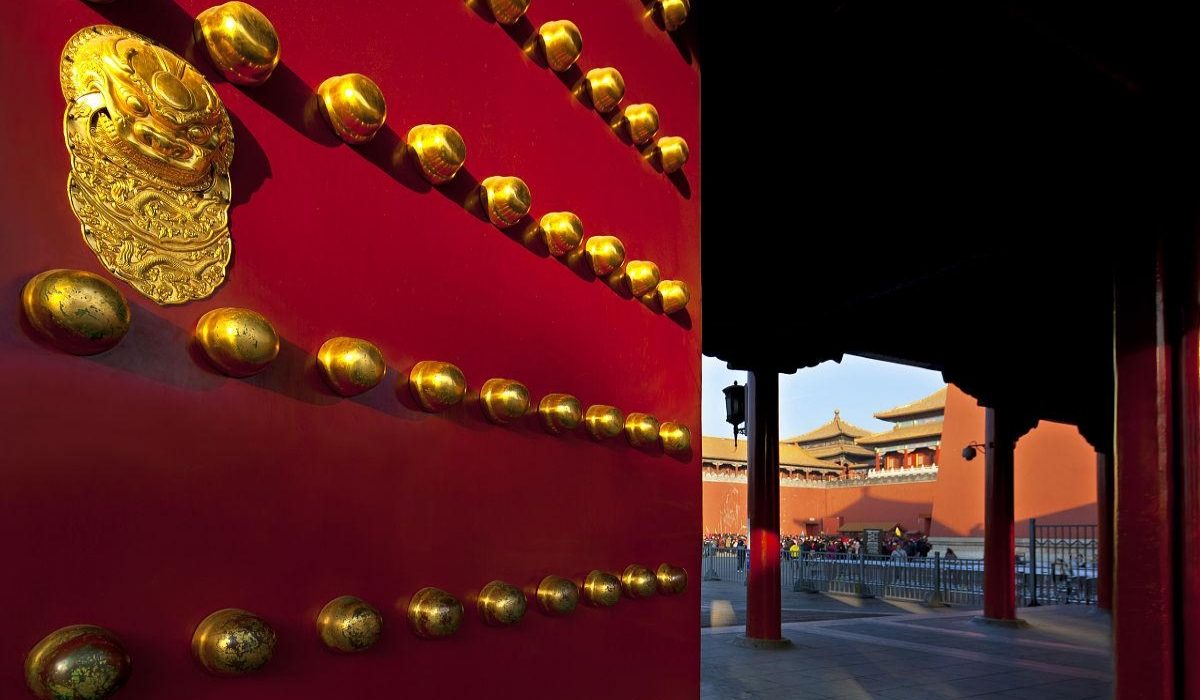
Even smaller, yet highly visible, architectural elements meticulously integrate the number nine. The four iconic corner towers, for example, are said to incorporate features based on multiples of nine, such as nine beams, eighteen posts (9×2), and seventy-two ridgepoles (9×8), showcasing an intricate numerical rule. Similarly, the grand palace doors are frequently adorned with 81 (9×9) gilded studs, arranged in nine rows of nine. These pervasive numerical patterns served as constant visual affirmations of the emperor’s supreme authority and his divine mandate, woven into every glance and detail of the imperial residence.


What Decorative Elements in the Forbidden City Showcase the Significance of Nine?
Beyond its structural dimensions, the number nine is exquisitely represented in the decorative arts and ornamental features throughout the Forbidden City. These artistic expressions not only enhance the palace’s beauty but also serve as potent visual reminders of imperial power.
How Does the Iconic Nine-Dragon Screen Highlight the Number Nine?
One of the most striking examples is the famous Nine-Dragon Screen, a magnificent glazed tile wall prominently displaying nine coiling dragons. The dragon itself is a powerful symbol of the emperor and imperial authority, and its depiction in groups of nine amplifies its auspicious and protective qualities. The screen’s intricate design, often involving elements such as 270 (a multiple of 9×30) pieces of colored glaze, further reinforces the imperial power associated with numbers nine and five, symbolizing boundless authority and protection for the palace and its ruler.
Why Are Roof-Ridge Beasts and Other Ornamentation Associated with Nine?
The roof ridges of imperial buildings within the Forbidden City feature a procession of zoomorphic figures, each with symbolic meaning. While common buildings might have fewer, imperial palaces often feature nine of these guardian beasts. The Hall of Supreme Harmony, being the most important building, uniquely features ten, signifying its unparalleled status and serving as a subtle nod to approaching divine perfection without fully usurping it. This deliberate numerical distinction in ornamentation reinforces the hierarchy and supreme authority of the emperor.


Frequently Asked Questions About Number Nine Prevails in the Forbidden City
How is the number nine represented in the architecture of the Forbidden City?
Nine is embedded in the layout and details of the palace complex. Examples include buildings that are nine bays wide, gates with nine rows of nails (81 in total), and decorative elements grouped in multiples of nine.
Why does the number nine represent the emperor specifically?
In Chinese cosmology, the emperor was regarded as the “Son of Heaven” (Tianzi). Nine, being the highest odd number under ten, symbolized supremacy and was therefore reserved to represent the ruler who stood at the pinnacle of earthly power.
Did commoners also use the number nine in their homes or decorations?
No. The number nine was reserved for imperial use. Commoners were not allowed to replicate these numerical patterns, especially the 9×9 door nails, as it was a sign of treason or disrespect to the emperor.